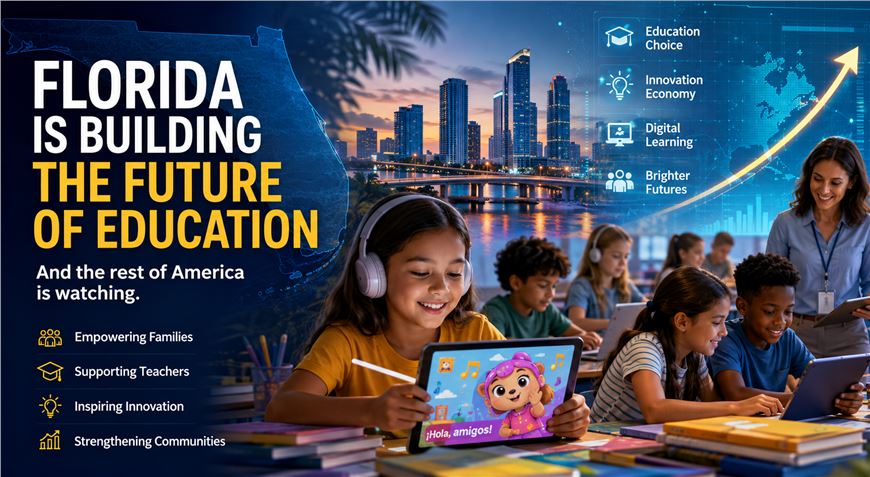
The state's expanding education-choice ecosystem may be creating an entirely new innovation economy—and projects like MimiHua offer a glimpse of what comes next.
History rarely announces itself.
When the internet first appeared, many believed it was simply a faster way to exchange information. Few imagined it would redefine commerce, entertainment, media, and nearly every aspect of modern life. The same happened with smartphones, which began as better mobile phones before creating an entirely new digital economy.
Something similar may be happening today in Florida. The recent expansion of the state's education-choice ecosystem has generated predictable political debate. Supporters celebrate greater freedom for families, while critics question the long-term effects on public education. Yet both sides may be overlooking the most significant consequence. Florida is not simply changing how education is funded. It is changing how educational innovation reaches children.
For decades, educational products followed a traditional path. New ideas moved through lengthy procurement processes, curriculum committees, institutional approvals, and bureaucratic timelines before they could ever enter a classroom. Even outstanding innovations often struggled to reach students. A different model is emerging. When families gain greater flexibility in educational choices, the marketplace changes. Schools can access new resources more quickly. Teachers gain new tools. Entrepreneurs, nonprofits, creators, and technology companies can develop solutions that compete on quality, engagement, and measurable educational value. History demonstrates that when distribution changes, innovation accelerates.
The internet transformed media.
The smartphone transformed software.
Artificial intelligence is transforming content creation.
Florida's education-choice policies may now transform educational innovation itself.
The next generation of educational platforms will likely look very different from those of the past decade. Children do not naturally separate learning from entertainment. They learn through stories, songs, repetition, movement, curiosity, and emotional connection. The educational experiences that succeed tomorrow will combine academic rigor with the engagement of modern media. This creates an extraordinary opportunity. Florida can become more than a leader in educational choice. It can become the birthplace of a new generation of educational companies built specifically for the needs of modern families and schools. Artificial intelligence is dramatically reducing the cost and time required to produce high-quality educational content. At the same time, family-centered educational policies are creating new pathways for innovative learning experiences to reach classrooms, homes, after-school programs, and multilingual communities. Together, these forces are giving rise to a new category of educational infrastructure.
Not simply textbooks.
Not simply software.
Not simply another app.
But integrated educational media ecosystems that combine intellectual property, technology, culture, music, storytelling, and classroom implementation into daily learning experiences.
One example is MimiHua, a Florida-based educational media initiative intentionally designed for this new environment. Rather than functioning solely as a language-learning application or a collection of videos, MimiHua combines original characters, multilingual education, music, classroom-ready lessons, teacher support, and AI-assisted production into a scalable learning ecosystem. Its ambition is larger than teaching vocabulary. It seeks to become an engagement layer within the new education-choice economy—an experience that children enjoy, teachers can easily integrate into their classrooms, and families can continue at home. In an era where educational success increasingly depends on sustained engagement, this model may prove as important as curriculum itself. This distinction matters because the conversation surrounding vouchers should not be limited to politics. The larger question is what kind of innovation this evolving ecosystem will inspire.
Will Florida simply finance different schools?
Or will it become the place where the next generation of educational brands is created?
The answer will depend on whether the state continues encouraging quality, accountability, creativity, and entrepreneurial thinking. If it does, Florida may establish itself not only as America's leader in educational choice but also as the world's leading laboratory for educational innovation. Years from now, today's voucher expansion may be remembered for something far greater than public policy. It may be remembered as the moment a new education innovation economy was born. And if that future arrives, projects like MimiHua may not merely participate in it—they may help define it.

EDITOR IN CHIEF
