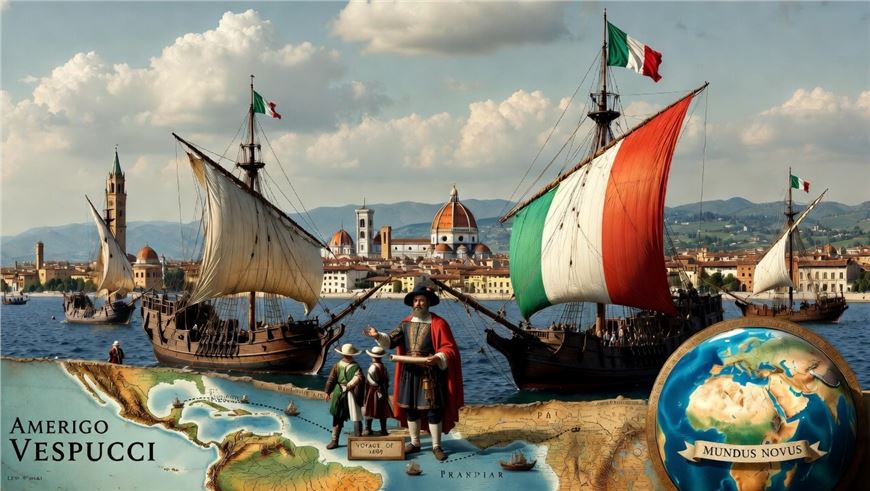
On this day, March 9, we mark the birth of Amerigo Vespucci, the visionary Italian explorer whose name eternally echoes in the identity of the New World.
Born in 1454 in the bustling city of Florence, Italy—then a cradle of Renaissance innovation—Vespucci's life and voyages underscore the deep, transformative influence of Italy on America. As we celebrate his 572nd birthday in 2026, it's an opportune moment to reflect on how this Florentine merchant-turned-navigator not only charted unknown waters but also symbolized the broader Italian contributions that have woven into the fabric of American history, culture, and society. From exploration to immigration, Italy's role in America's story is one of profound importance, fostering a transatlantic bond that endures today.
Vespucci hailed from a prominent family in Florence, the epicenter of the Italian Renaissance. Educated in the humanities and sciences under the tutelage of his uncle, a Dominican friar, he initially pursued a career in commerce, working for the powerful Medici family. Florence, with its thriving ports and intellectual fervor, ignited his curiosity about the world beyond Europe. By the late 1490s, Vespucci embarked on expeditions sponsored by Spain and Portugal, sailing across the Atlantic in search of new trade routes. Unlike Christopher Columbus, another Italian (from Genoa) who believed he had reached Asia, Vespucci astutely recognized that the lands he encountered—along the coasts of present-day South America—were part of an entirely new continent.
His voyages, documented in letters like the famous "Mundus Novus" (New World) published in 1503, detailed encounters with indigenous peoples, exotic flora and fauna, and vast landscapes. Vespucci's meticulous observations, including astronomical measurements that confirmed the southern hemisphere's expanse, challenged prevailing geographic dogmas. In 1507, German cartographer Martin Waldseemüller, inspired by Vespucci's accounts, labeled the new continent "America" on his world map—the feminine Latin form of Amerigo. This naming was no accident; it honored Vespucci's insight that these were not the Indies but a separate landmass. Thus, Italy gifted America its very name, a testament to the intellectual prowess emanating from the Italian peninsula during the Age of Discovery.
Beyond Vespucci, Italy's importance to America extends through a lineage of explorers and innovators. Columbus's 1492 voyage, funded by Spain but driven by Italian ingenuity, opened the door to European colonization. Giovanni da Verrazzano, from Florence like Vespucci, explored the North American coast in 1524, mapping what would become New York Harbor. These pioneers laid the groundwork for transatlantic exchange, introducing European ideas, technologies, and goods to the Americas while bringing back knowledge that fueled the Renaissance's global expansion. Italy's maritime republics—Venice, Genoa, Pisa—had long mastered navigation, shipbuilding, and cartography, skills that directly influenced the exploratory zeal leading to America's "discovery."
The Italian impact didn't stop at exploration. Waves of Italian immigrants in the late 19th and early 20th centuries profoundly shaped modern America. Between 1880 and 1920, over four million Italians arrived, fleeing economic hardship and seeking opportunity. They built infrastructure—laying railroads, constructing skyscrapers like the Empire State Building—and enriched American cuisine with staples like pizza, pasta, and espresso, now integral to daily life. Figures like Fiorello La Guardia, New York's first Italian-American mayor, championed progressive reforms, while inventors like Antonio Meucci contributed to the telephone's development, predating Alexander Graham Bell. In the arts, Italian-Americans such as Frank Sinatra and Martin Scorsese have defined American entertainment, blending Old World heritage with New World innovation.
Culturally, Italy's Renaissance ideals—humanism, art, and science—resonate in American institutions. The U.S. Capitol's design draws from Roman architecture, and the Founding Fathers, inspired by Italian thinkers like Machiavelli and Beccaria, incorporated republican principles into the Constitution. Today, economic ties flourish: Italy is a key NATO ally, and bilateral trade exceeds $100 billion annually, with Italian brands like Ferrari and Gucci symbolizing luxury in American markets. Educational exchanges, such as Fulbright programs, continue to bridge the nations, while Italian-American communities celebrate heritage through festivals like New York's Columbus Day Parade—though evolving to honor broader Italian contributions amid debates over historical figures.
Vespucci's legacy reminds us that America's story is incomplete without Italy's chapter. His birthday invites reflection on how a single Italian's curiosity named a hemisphere, sparking centuries of mutual enrichment. In an era of global challenges, this Italo-American bond—rooted in exploration, immigration, and shared values—offers lessons in resilience and collaboration. As we honor Vespucci today, let's toast to Italy's enduring gift: not just a name, but the spirit of discovery that defines America.

Roberto Masiero
